


How Xcat Takes a Different Approach to Helping Sellers Get Found
There are many selling sites available to businesses and independent sellers today.
Large marketplaces such as eBay and Amazon give sellers access to enormous audiences, while other selling sites specialise in particular products, local selling or specific types of customer.
For many sellers, using more than one marketplace can make sense. Different selling sites provide different audiences, fee structures and opportunities.
Xcat Marketplace is being built to offer something different.
Rather than simply providing another place to upload a product listing, Xcat is developing an interconnected marketplace where products, detailed specifications, filters, guides, articles, community discussions and practical tools work together to create multiple ways for buyers to discover seller products.
What Makes One Selling Site Different From Another?
At their most basic level, selling sites connect people who have products to sell with people who want to buy them.
But how customers actually discover those products can vary considerably.
On a large marketplace, customers often arrive knowing roughly what they want. They search for a product, browse a category, compare listings and make a purchasing decision.
That model can be extremely effective.
However, not every potential customer begins their journey by searching a marketplace.
People also search Google for questions, problems, compatibility information, product comparisons, technical advice and buying guidance.
Xcat is being developed to connect these different types of product discovery.
Xcat Is Building Multiple Product Discovery Funnels
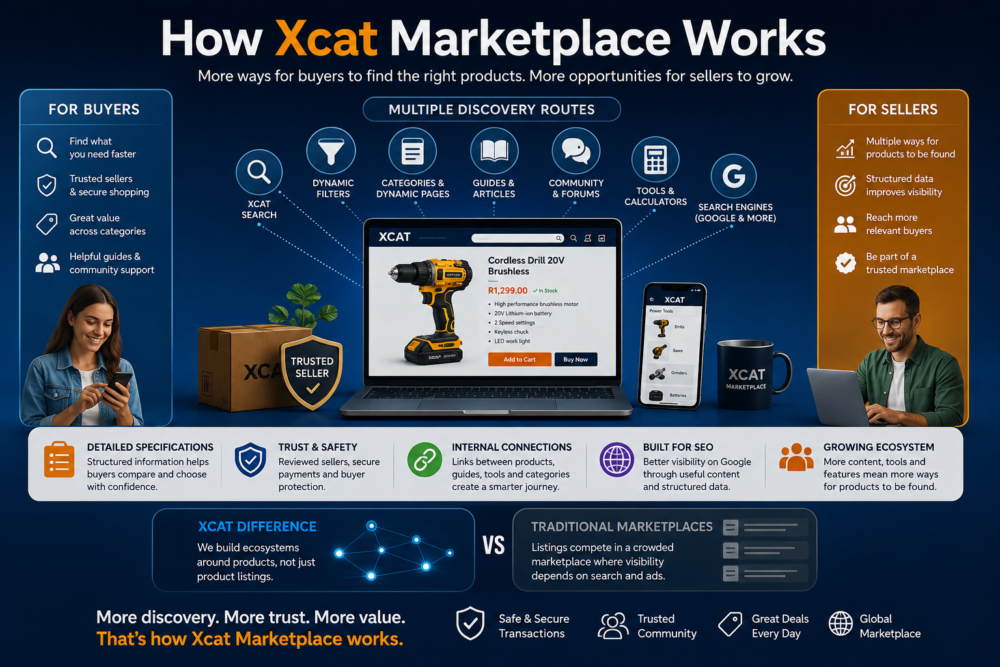
One of the key differences between Xcat and many conventional selling sites is our focus on creating multiple discovery funnels around marketplace products.
A discovery funnel is simply a route through which a potential customer can eventually reach a relevant product.
A customer might discover an Xcat seller's listing through:
- An Xcat marketplace category
- A Dynamic Filter
- Xcat search
- A dynamic product page
- A Product Finder
- A buying guide
- A technical guide
- An Xcat article
- A community or forum discussion
- A calculator or practical tool
- An internal link from another relevant Xcat page
- A Google or other external search-engine result
These different routes can ultimately lead customers towards the same seller listing.
Sellers therefore do not need to create duplicate products simply to participate in different areas of the Xcat marketplace.
Why Product Specifications Matter
Xcat uses category-specific Specification Templates to collect structured information about products.
Depending on the product, these specifications might include:
- Brand
- Model
- Size
- Capacity
- Voltage
- Power
- Connectivity
- Compatibility
- Materials
- Technical features
This information obviously helps a customer understand the product.
But Xcat is being designed so that specifications can do considerably more.
Structured product information can support filtering, marketplace search, product comparisons, Product Finder tools, compatibility systems, dynamic pages and future intelligent product-discovery features.
It also gives search engines additional context for understanding what a product is.
This is why Xcat encourages sellers to complete as many relevant and accurate specifications as possible, even when some fields are optional.
Dynamic Filters Create More Ways to Browse Products
Large category trees can quickly become difficult to navigate.
Xcat therefore uses Dynamic Filters to organise different product types within broader product ecosystems.
For example, within Mobile Phones & Accessories, customers might be able to narrow products to Mobile Phones, Cases & Covers, Chargers, Charging Cables, Power Banks and other relevant product types.
This makes browsing easier for customers.
But Xcat's longer-term strategy goes further.
Selected filters can also develop into dedicated dynamic product pages, providing another relevant route through which customers and search engines can discover products.
The underlying seller listing remains the same.
Xcat Guides Can Lead Customers Towards Products
Someone looking for a product doesn't always know exactly what they need.
They might instead search for questions such as:
- Which battery fits my tool?
- What size drill bit do I need?
- How powerful should my charger be?
- How much storage do I need on a mobile phone?
A useful Xcat guide can answer the question first.
Where appropriate, that guide can then connect the customer with relevant product groups and marketplace listings.
Question → Useful Information → Product Understanding → Relevant Products
This allows Xcat to reach potential customers earlier in their buying journey.
Articles Create Additional Discovery Opportunities
Xcat articles provide another route into the marketplace.
Articles can cover buying decisions, product technologies, comparisons, marketplace topics and practical information.
A visitor may discover an Xcat article through a search engine without initially intending to visit an online marketplace.
Relevant internal links can then help that visitor explore related guides, categories, Dynamic Filters and products.
Rather than treating editorial content and ecommerce as completely separate parts of the website, Xcat aims to connect useful information with relevant marketplace products.
Community Discussions Can Also Help Product Discovery
The Xcat Community creates another layer of useful content.
Product questions, compatibility discussions, marketplace announcements and other public conversations can help visitors find information about subjects they are researching.
Where appropriate, these discussions can connect customers with relevant Xcat resources and product areas.
Over time, this helps create a growing network of information surrounding Xcat's marketplace categories.
Practical Tools Can Bring Buyers Into the Marketplace
Xcat is also developing practical tools, calculators and Product Finders.
Someone using one of these tools may arrive because they need help completing a particular task rather than because they were initially looking for a selling site.
Once the tool has helped answer their question, relevant products can be presented naturally as part of the solution.
Problem → Tool → Answer → Suitable Product
It is another example of how Xcat's marketplace and informational resources can work together.
How Does This Help SEO?
SEO — Search Engine Optimisation — is an important part of Xcat's long-term marketplace strategy.
Google and other search engines need to discover pages and understand what those pages are about.
A marketplace consisting only of isolated product listings has fewer opportunities to explain the relationships between products and the subjects surrounding them.
Xcat therefore aims to create interconnected product ecosystems.
A product can be associated with its category, Dynamic Filter, structured specifications, relevant guides, articles, discussions, tools and other related resources.
Internal links connect those resources.
This can help both customers and search engines understand how different parts of the Xcat marketplace relate to one another.
SEO never provides guaranteed rankings, traffic or sales. Search engines determine their own results.
However, useful original content, accurate structured product information and relevant internal linking provide a stronger foundation for organic product discovery.
How Is Xcat Different From Selling Sites Such as eBay and Amazon?
eBay and Amazon are established global marketplaces with enormous customer audiences and sophisticated product-discovery systems.
Xcat is not attempting to reproduce those platforms on a smaller scale.
Instead, Xcat is developing a different approach.
Our aim is to surround marketplace products with useful information and multiple discovery routes.
A seller's product does not have to exist only as an isolated listing waiting for somebody to search for it.
It can potentially become part of a wider ecosystem consisting of:
Products → Specifications → Dynamic Filters → Dynamic Pages → Guides → Articles → Community → Tools → Search Engines
Each part of that ecosystem can provide another opportunity for a relevant customer to encounter the product.
That interconnected approach to product discovery and seller visibility is one of the ways Xcat aims to differentiate itself from traditional selling sites.
Xcat Can Be Part of a Multi-Channel Selling Strategy
Choosing Xcat does not necessarily mean leaving other selling sites.
Established platforms can provide sellers with substantial audiences, and different marketplaces have different strengths.
For many businesses, a sensible strategy is to sell through multiple channels rather than depend entirely on one marketplace.
Xcat can provide another sales channel while developing additional ways of connecting products with customers.
As Xcat grows, sellers can benefit from the marketplace infrastructure and from the wider network of product information being developed around it.
What Can Sellers Do to Improve Their Visibility on Xcat?
Xcat can build the discovery infrastructure, but the quality of the seller's product information remains extremely important.
Sellers should:
- Select the correct category
- Choose the most accurate Dynamic Filter
- Complete relevant Specification Template fields
- Use clear and descriptive product titles
- Write useful and original Short and Full Descriptions
- Avoid duplicating description content
- Upload good-quality product images
- Describe product condition accurately
- Provide accurate compatibility information
- Keep stock and product information current
The better Xcat understands a product, the more effectively its developing systems can determine where that product is relevant.
A Different Kind of Selling Site
There are already many established selling sites available to UK businesses and independent sellers.
Xcat does not need to become another identical marketplace.
We're building Xcat around a different principle:
Help people discover useful information, understand what they need and connect them with relevant products.
Categories, specifications, Dynamic Filters, guides, articles, community discussions, Product Finders and practical tools all contribute to that objective.
For buyers, the aim is easier and more useful product discovery.
For sellers, the aim is to create more opportunities for the right customers to find their listings.
That is the marketplace Xcat is building.